Showing posts with label COVID-19. Show all posts

Wednesday, January 27, 2021

HEALTH | COVID-19 vaccine: Strides toward equity, access demanded

By Susan Tebben


Marko Geber/Getty Images.

As COVID-19 vaccine distribution slowly but surely continues in the state, minority populations still represent a small percentage of those that have received the vaccine, and officials and advocates say more strides toward minority equity and access need to happen.

Ohio Gov. Mike DeWine hasn’t wavered in recent messages that vaccine doses coming to the state are scarce.

“We know there’s not enough,” DeWine said again on Tuesday.

As of Tuesday, state data showed 5.62% of the state’s population, or more than 656,000 people, had “started the vaccine,” meaning they have received at least the first dose of the two-dose vaccine. Statewide, 4.63% of white Ohioans have received at least their first dose. The Black population only represents 2.07% of those who’ve begun vaccination.

Kaiser Family Foundation analysis showed, as of Jan. 19, the demographic distribution for vaccines was 82% white and 6% Black.

Some data is missing from the analysis, with 19% of the vaccination distribution showing “unknown race” and 24% showing “unknown ethnicity.” A spokesperson for the Ohio Department of Health said the race and ethnicity data is voluntarily filled in by the person receiving the vaccine, so the department does not control whether that data is completed.

The absence of or small amount of data showing people of color receiving the vaccine — though reporting of vaccine distribution is still in its early stages — could stem from a continuing distrust by the Black community and people of color of vaccines and the government’s implementation of public health.

“We’re still monitoring the data, but the the fact of the matter is that our health care system is not set up to serve Black Americans well,” said Hope Lane, policy associate at Ohio-based think tank Center for Community Solutions.

Lane said the Tuskegee Experiment, in which Black participants were intentionally not treated for syphilis, and the experiments conducted on Black women in the early days of gynecology are “not so distant history,” and a shortage in doctors and pharmacists of color doesn’t help the hesitancy some have in receiving treatment or vaccines.

That situation combines with a lack of forethought in the plans for vaccine distribution, according to Lane.

“There are drive-up sites, but when you don’t have a car you can’t drive-up,” Lane said. “There’s just things like that are part of the lack of access.”

Even statewide distribution of the vaccine to pharmacies does not equal access in some areas.

“Putting it just in pharmacies doesn’t work in communities like Dayton, because we have food deserts and prescription deserts in our African-American communities,” said Dayton Mayor Nan Whaley on Tuesday.

Whaley was a part of a press conference to push for a new COVID-19 funding plan put together by President Joe Biden, but said strategies around getting the vaccine into minority communities must occur on the local, state and federal level to work.

That includes bringing the vaccine to places where the communities gather, like churches. Of the 800 vaccines Public Health of Dayton & Montgomery County received recently, 200 of those were placed at St. Margaret’s Church in west Dayton, according to Whaley.

“So (the vaccine) would be in a place that is trusted in our community, connected to our community, for the African-American community,” Whaley said.

Carol Smith, a retired nurse from the Ohio State Penitentiary emphasized the need for education and outreach in order to get past the fears that are present because of the history of the country’s health care system.

“We must acknowledge the concerns and acknowledge that these concerns are legitimate,” Smith said during the press conference. “Here comes the paramount role of education to those around us, who need encouragement and the knowledge to educate themselves and others.”

DeWine has said the state government will begin some “communication and education strategies aimed at minority communities,” such as town halls, marketing campaigns, and a “tool kit” for community partners to address vaccine hesitancy.

On Tuesday he mentioned partnerships with churches as another way to “make sure we’re covering everyone in the state of Ohio.”

“It’s an ongoing effort,” DeWine said. “We’re not there yet, but it is what we’re going to strive for, what we’re going to continue to strive for.”

The efforts will begin Feb. 8, DeWine said, aligning with the week vaccines are scheduled to be distributed to Ohioans aged 65 and older. That week, vaccines will be taken directly to “affordable senior housing” facilities, where DeWine said the threat of serious illness is high because of the age of the residents and “potential barriers to accessing the vaccine.”

• • •• • •

This story is provided by Ohio Capital Journal, a part of States Newsroom, a national 501 (c)(3) nonprofit. See the original story here .

Monday, January 25, 2021

OHIO POLITICS | State rep. again calls for virtual hearings, testimony during pandemic

 By Tyler Buchanan

Members of the Economic Recovery Task Force are seen at a virtual meeting in April. A state representative wants to see the Ohio General Assembly allow for virtual committee hearings and testimony with the pandemic ongoing.

When Ohio business owners were asked early on in the pandemic to share their concerns with lawmakers, they were given a chance to do so via Zoom video conference.

And when lawmakers on the Ohio Controlling Board hold regular meetings, they discuss budgetary issues with agency officials on a similar digital platform.

But ordinary Ohioans wanting to testify in favor and against proposed laws must still travel to the Ohio Statehouse in Columbus to be heard directly by their legislators.

A Democratic state representative is once again urging the Ohio General Assembly to allow for virtual committee hearings and testimony as the state continues to battle the COVID-19 pandemic. Rep. Brigid Kelly of Cincinnati introduced resolutions near the end of the previous legislative term seeking these rule changes. She announced plans to introduce them again with the 134th General Assembly kicking off this month.

State Rep. Brigid Kelly, D-Cincinnati

“No one should have to choose between their health and wellbeing and having their voice heard,” she stated in a news release. 

Dozens of advocacy organizations whose members often testify on legislation are similarly calling digital testimony going forward. While people can submit written testimony to committee members, testifying directly allows for questioning and extended dialogue on a given subject.

In a letter to House Speaker Bob Cupp, R-Lima, and Senate President Matt Huffman, R-Lima, the groups argue “our democracy works best when all of us are involved and when all of us have equitable access to it.” 

The groups point to the coronavirus health concerns as well as broader challenges brought about by the pandemic. Parents and caregivers may not be able to travel to and from Columbus to have their voices heard, the letter contends.

“Ohioans balancing these increased demands of caregiving and family responsibilities can be met with insurmountable obstacles in having their voices heard at the Statehouse because they cannot partake in person,” the letter continues. “Additionally, the health and wellbeing of legislative and Statehouse staff and members of the press corps are at risk when there is an increase in the number of people with whom they come into contact at the Statehouse.”

Besides digital meetings of the House Economic Recovery Task Force and Ohio Controlling Board, lawmakers also approved a bipartisan bill to let university trustees attend their meetings electronically. 

Rep. Susan Manchester, R-Waynesfield, said during a committee hearing the bill’s passage was “imperative to the functionality and safety of state university boards and their trustees” during the “unprecedented times of the COVID-19 pandemic.”

The bill passed unanimously in the Ohio Senate and near-unanimously in the Ohio House of Representatives.

• • •• • •

This story is provided by Ohio Capital Journal, a part of States Newsroom, a national 501 (c)(3) nonprofit. See the original story here.

Monday, January 04, 2021

Indigent burial program may see more action amid opioid epidemic, COVID-19 pandemic

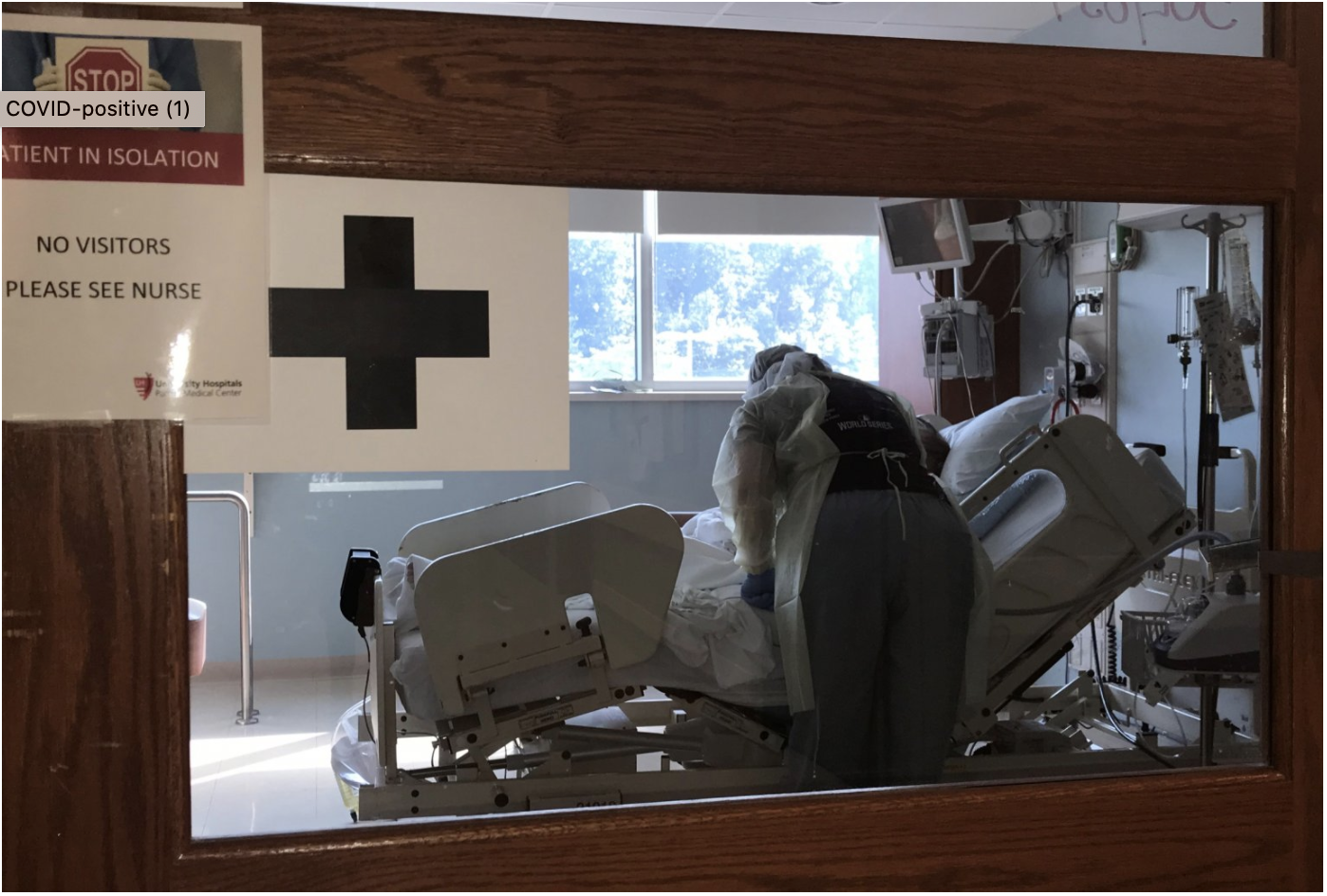
Medical staff tend to a COVID-19 patient. Courtesy of University Hospitals


By Susan Tebben
 

A state program to help those who can’t afford to bury their loved ones might see more action than usual and cause the need for re-education for townships that have to pay for these burials.

The Indigent Burial and Cremation program works with townships and municipalities to reimburse some of the costs of funeral disposition. When a resident is found to fall below the federal poverty line, Ohio law requires that a local government pay for the burial or cremation.

But local government officials have said the program wasn’t used often in its last version, nearly two decades ago.

More recently, however, several townships have called the state’s Board of Embalmers and Funeral Directors to get information about the program, and there are currently 450 applications being processed, according to Cheryl Grossman, the board’s executive director.

“We look for that number to grow dramatically,” Grossman said.

While a death certificate isn’t required with the application for funding reimbursement, Grossman and others have said the ongoing opioid epidemic and the COVID-19 pandemic could cause the program to have increased use.

“The opioid crisis is not going away and in some places it’s only being exacerbated by the COVID-19 crisis,” said Heidi Fought, executive director of the Ohio Township Association.

The program was a part of the budget more than a decade ago, but budget cuts led to the elimination of it until the last budget bill, passed in July of 2019.

The new budget line item moved the program from the state Department of Job and Family Services to the Board of Embalmers and Funeral Directors and allowed the reimbursement of a total of $2 million.

Under the new version of the program, a township can get reimbursed for up to $1,000 in burial or cremation expenses for an adult, and up to $750 for a child. Those numbers are a slight increase from the previous program, where reimbursements were set at $750 for an adult and $500 for a child.

The Board of Embalmers and Funeral Directors seems to be the only state agency with information on the program. Representatives from the Ohio Department of Job and Family Services, the Department of Health, the Office of Budget and Management and the Auditor of State all referred questions about the use and payment of the program to the board.

“While the local governments in the Southeast Region receive some funding, it is usually sporadic and nominal,” said Denise A. Blair, assistant chief auditor in the Southeast Region for the Auditor of State. “It would not rise to the level of materiality that would be included in our scope.”

The OTA specifically lobbied to bring back the funding for the indigent burial program in the last budget, despite the rarity of a cut program returning to the state budget.

“The fact that it did come back does show that the need is there,” Fought said.

The need to re-educate townships on the existence of the program and how to be reimbursed for it is also there, because of the turnover over of local officials in the period between the program’s existence, according to Fought.

Only local government representatives can apply for the reimbursement, so individuals have to go through those government officials to get help with their funeral disposition.

The Ohio Township Association says the push to increase the program’s funding will continue, especially considering local governments are required to pay for indigent burials whether or not there is money in the program’s coffers to reimburse them.

“A local government entity must carry out this duty even if funds are no longer available through the program,” according to the embalming and funeral directors board page on the program.

The program is needed as a state program because poverty does not focus on one particular county, nor does the need for burials or cremations.

“Indigency knows no boundaries,” said Fought. “They’re in central Ohio or Cleveland or Cincinnati, they’re everywhere.”

• • •• • •

This story is provided by Ohio Capital Journal, a part of States Newsroom, a national 501 (c)(3) nonprofit. See the original story here.


Sunday, November 08, 2020

The Struggle Continues

From an online article in The Smithsonian magazine

By R. T. Andrews

‘Lord, we ain’t what we oughta be. We ain’t what we want to be. We ain’t what we gonna be. But thank God, we ain’t what we was.’

That sentiment, expressed by Martin Luther King at an Emancipation centennial event in 1962, can be felt across much of the land this morning.

You could sense the nation’s collective sigh of relief last night as the country began the ceremonial transition, from its Tasmanian devil of a president and his wooden sidekick of a veep, to the reassuring presence of an Uncle Joe, accompanied by his potential rock star of a governing partner, Kamala Harris.

‘Lord, we ain’t what we oughta be. We ain’t what we want to be. We ain’t what we gonna be. But thank God, we ain’t what we was.’

The United States in 1862 was a nation literally at war with itself. Rebels were fighting to preserve a way of life that other parts of the country wanted to leave behind: chattel slavery, religious bigotry, nativism, xenophobia.

For the past four years it seems as if those alternative visions of the world were still being contested. Make America Great Again was a very thin code for a nostalgic call to a past where black people were underfoot, women were in the kitchen, gays were in the closet, and white men were ascendant, under precious few obligations of restraint. Police busted heads on the regular without fear of reprisal, women were silent over all manner of violation, shaming and disbelief being normal consequences for truth telling. Anything outside of an able bodied heterosexual white man was deviant and ‘less than’ by definition.

The irresistible forces of diversity — which is to say, the natural conditions of humankind — have been taking it on the chin and in the solar plexus these last four years. The assault has been played out relentlessly on the airwaves: governance by ego, rooted in confederate nostalgia and counterfeit reality, manipulated offstage as always by forces of unmitigated greed that produce historic wealth inequality.

While the trumpian coronavirus has been momentarily exorcised from the White House, its residence there did incalculable damage to the organs of America: our infrastructure of government, our politics, our society, and our culture.

To expect a Biden administration to restore the status quo that existed before trumpism entered the open sores of our society is fantasy. For the moment we can breathe more easily because the inflammation has receded, that incessant tweeting pain has subsided.

But COVID-19 is still here, wreaking havoc with our health and our economy. To defeat it will require and the immediate attention and intelligent aggression of the new administration, as well as patience by American citizens, who are already fatigued by mask-wearing, social distancing, Zoom meetings, and lost conveniences.

Patience has seldom been a virtue of our national character. While Trump fatigue may be in our rear view mirror, one early measure of the Biden administration will be its ability to forge sufficient consensus around mask-wearing and quarantines while an effective vaccine is developed and distributed.

That won’t be easy. The new president will have a thin margin in the House and implacable opposition in the Senate. Majority Leader Mitch McConnell may extend some good ol’ boy collegiality towards Biden, a former colleague, but he will continue to stand resolutely in the gap against anything remotely resembling progress.

Vice President-elect Kamala Harris superimposed upon the shadow of Norman Rockwell's
1964 illustration of six-year old Ruby Bridges as she was accompanied by US Marshals in the
desegregation of public schools in New Orleans.

Finally, a word on the new Vice President. It is of course far too early to tell, but her elevation to national leadership status may prove to be the most consequential harbinger of a new generation. Barack Obama cracked open a door in a notorious manner, ushering in a twenty-four second “post-racial” America that was immediately followed by in true American fashion by nativistic American backlash. But Kamala Harris, on the strength of black women, has eased into the sidecar seat, from which she is positioned both symbolically and realistically, to change the landscape irrevocably.

To put it another way, there was no guarantee that the Jackie Robinson experiment to integrate major league baseball would succeed. If Obama was Jackie, Kamala is Willie Mays and Roberto Clemente. There is no turning back.

• • •• • •


Tuesday, November 03, 2020

Millions head to polls as COVID-19 afflicts record numbers of Ohioans

 By Jake Zuckerman

Voters in line to vote early on Oct. 24 before the Board of Elections opened. Voters shown here at 8am are on the InnerBelt ramp in a line that snaked around the Cuyahoga County Board of Elections. There was an estimated two hour wait to vote from the end of the line.

On March 16, the state health department reported that 13 more Ohioans tested positive for COVID-19, bringing the cumulative known caseload to 50.

Just after 10 p.m., Gov. Mike DeWine announced that Ohio Department of Health Director Dr. Amy Acton issued an order delaying the primary election, scheduled for the next day.

The announcement seemingly ignored Common Pleas Judge Richard Frye’s rejection of a lawsuit just hours earlier seeking to delay the election. DeWine and Secretary of State Frank LaRose helped orchestrate the lawsuit.

Acton’s order cited the “imminent threat” of “widespread exposure” to COVID-19.

“It is clear from history and experience that large number[s] of people gather at polling locations which increases the risk of transmission of COVID-19,” the order states. “To conduct an election at this time would force poll workers and voters to face an unacceptable risk of contracting COVID-19.”

Times have changed.

On Monday, ODH reported 2,900 more Ohioans contracted COVID-19. More than 1,800 are currently in the hospital with the disease, and more than 5,300 have died since March.

Regardless, thousands of Ohioans will pour into poll locations Tuesday to pick a president, two state Supreme Court justices, state senators and representatives, and scores of down-ballot candidates and issues.

Of course, there are some key differences: our collective understanding of the virus, how it spreads and who’s at risk has evolved; our risk tolerance has developed while we figure out how to navigate ordinary life during an extraordinary health crisis; evidence-backed personal protective equipment is more readily available; and the state has more control over its primary election than a general election.

The contrast is nonetheless stark.

The incubation period for COVID-19 can be up to 14 days, according to the CDC. Over the last 14-day period ending Monday, more than 38,000 Ohioans contracted COVID-19. The close contacts (within six feet for a total of 15 minutes or more) of people known to be infected are advised to quarantine as well.

Secretary of State Frank LaRose issued guidance to county boards of elections, advising them to utilize curbside voting for people who tested positive or may have been exposed to COVID-19.

“No matter what, every eligible voter who wishes to vote must be permitted to do so after they are asked to consider safer alternatives,” the guidance states.

A spokeswoman said Tuesday LaRose has also implemented an emergency option, allowing people who have been ordered to isolate or quarantine since noon Saturday to request an absentee ballot before 3 p.m. Tuesday.

Melanie Amato, an ODH spokeswoman, said Tuesday that the department does not plan on issuing any orders to halt the election or prevent anyone from voting.

“The state of Ohio has now had nine months to learn and study COVID-19,” she said. “When the original order was issued in March, Ohio was just starting to have positive cases. We were still learning and did not have the precautions in place that we do now. Now with a mask mandate, social distancing, safety precautions for poll workers and more knowledge about the virus, we feel people can remain safe when heading to the polls.”

State lawmakers went on to rework the primary into an all-mail affair with an April 28 deadline. What effect, if any, the coronavirus could have on Tuesday’s election remains unclear.

As of 2 p.m. Monday, LaRose said 3.4 million Ohioans have cast their ballot early in person, via drop box, or by mail. One day before the 2016 election, that number was 1.8 million.

The presidential race has in many ways been defined by the pandemic. President Donald Trump has insisted, without evidence, the pandemic is “rounding the corner.” The campaign has hosted large-scale rallies with few wearing masks or social distancing. Trump has spent months downplaying the virus and caricaturizing it as a media hoax. He floated the idea of firing the federal government’s top infectious disease expert, Dr. Anthony Fauci, on Sunday after Fauci criticized Trump’s handling of the pandemic in an interview with The Washington Post.

Meanwhile, Democratic challenger Joe Biden has generally opted against large rallies, frequently wears his mask during public appearances, and criticizes the president for hosting “super spreader” events — including one at the White House believed to have infected Trump and more than 20 contacts including aides, U.S. Senators and journalists.

In Ottawa County, the virus and the election are set to literally converge: The county health department’s boardroom has been retooled into a poll location.

According to Cleveland.com, the county has picked the winner of the presidential race in each of the last 14 elections. It turned red Oct. 22 on Ohio’s Public Health Advisory System map, indicating “very high rates of exposure and spread.”

Health Commissioner Jerry Bingham said he’s focused on stopping spread within households and at social gatherings. If people wear masks and socially distance at the polls, voting will be safe, but he said everybody must buy in.

“Back in March, this was such a new virus,” he said. “Over the months, there have been a lot of new discoveries about what works well, what doesn’t, how infectious it is. I’d say we know a lot more about the virus than in March.”

That said, LaRose’s guidance to boards of election hints at the bitter national divide regarding masks. It says poll workers should “encourage” voters to wear masks but cannot force them to.

“Do not engage in underlying issues that may factor into the objection,” the guidance warns.

The CDC offers its own guidance for voting during the pandemic: masks, hand hygiene, social distancing, and getting in and out as quickly as possible.

“Voters who are sick or in quarantine should take steps to protect poll workers and other voters,” it states. “This includes wearing a mask, staying at least 6 feet away from others, and washing your hands or using hand sanitizer before and after voting. You should also let poll workers know that you are sick or in quarantine when you arrive at the polling location. Check with local authorities for any additional guidance.”

This story is provided by Ohio Capital Journal, a part of States Newsroom, a national 501 (c)(3) nonprofit. See the original story here.

• • •• • •


Monday, November 02, 2020

County-by-county COVID-19 response ‘will not work,’ Harvard epidemiologist says

By Jake Zuckerman


Ohio Gov. Mike DeWine. Photo by Scott Olson/Getty Images.


A Harvard epidemiologist cast skepticism on Gov. Mike DeWine’s emphasis on forming “COVID defense teams” to respond to the pandemic on a county-by-county basis.

Dr. Michael Mina, an assistant professor of epidemiology at Harvard University’s T.H. Chan School of Public Health, said a “patchwork approach” of uneven policy applications is doomed to fail.

“As long as we’re doing this in a haphazard, individual district-by-district way, it simply will not work,” he said.

He said the virus pays no attention to political constructs like county lines, and that communities cannot control the virus with an “asynchronous” response — if community A drives case counts down, it’s only so long until community B’s more relaxed approach bleeds over.

On Thursday, DeWine said he was calling on county leaders in every community to form “COVID defense teams.” He said they’d be comprised of mayors, commissioners, hospital executives, business leaders and others.

This comes as the epidemic in Ohio has soared to new heights — more Ohioans were infected with COVID-19 this week than any other during the pandemic. Similarly, more Ohioans are in the hospital Sunday with COVID-19 than any other point in history.


The county COVID-19 defense teams will focus on what resources are available in the community, where its problem lies, and what can be done to turn things around, DeWine said.

“Things happen at the local level,” he said. “Somebody at the local level who might not think they should wear a mask is a lot more likely to listen a neighbor than they are to me, or than they are to (Dr. Anthony Fauci, the federal government’s top infectious disease expert).”

Responding to Mina’s criticism, DeWine spokesman Dan Tierney said the teams are a supplement, not a replacement, to work the state is doing.

“We’re asking for more players in the field,” Tierney said.

DeWine said contact tracers and local health authorities are sounding alarms that they’re seeing spread at events like family gatherings, funerals, and weddings, more so than regulated spaces like bars and restaurants.

State policy, to be sure, drives much of Ohio’s COVID-19 response. The Ohio Department of Health, part of DeWine’s administration, has mandated masks, restricted alcohol sales on site at bars and restaurants, and implemented mass gathering and capacity restrictions on a statewide basis.

Significantly, however, it has left decisions on schools to local communities.

DeWine has repeatedly said there are no lockdowns or government responses of similar character looming, although he has said he wouldn’t rule them out entirely.

The ranking Democrat in the state House of Representatives, Emilia Sykes, criticized DeWine’s announcement Thursday.

“A county-by-county, city-by-city plan is no substitute for the statewide COVID response,” she said. “I understand delegation, but this is a dereliction of duty. This will not end well for Ohioans.”


‘A long winter’

Mina, speaking to reporters, warned the pandemic is moving in the wrong direction in the U.S.

The virus overcame “seasonal barriers” and continued to spread this summer. Now, colder weather is driving people inside, where the virus is more likely to spread. Plus, transmissibility increases as humidity decreases, all making for a deadly confluence.

“Unfortunately, we are, I think, in for a long winter,” he said.

Ohio and other states missed the chance to drive down case counts in June, July and August, he said, which could have set them up to confront the winter from a better position.

This, coupled with large scale rallies for President Donald Trump that continue to occur, could force states into uncomfortable positions if current trends continue.

“They’re going to be forced to shut down,” he said.

In Ohio, at least 219,000 residents have been infected with COVID-19. More than 19,000 have been hospitalized with the disease. More than 5,300 have died.


This story is provided by Ohio Capital Journal, a part of States Newsroom, a national 501 (c)(3) nonprofit. See the original story here

• • •• • •


Tuesday, October 27, 2020

19 Ohio lawmakers declared victory over COVID-19 in June. Now it’s spreading in their districts


By Tyler Buchanan 


Back in June, 19 state legislators joined together to claim that “Ohio smashed the curve long ago. Mission accomplished!”

Months later, as Ohio continues to set new records for COVID-19 cases and hospitalizations, one of those legislators admits the pandemic has proved to be an “evolving situation.” Another is doubling down on the letter’s message and suggests the data recent spike in cases may be inaccurate. 

The letter’s author, state Rep. Craig Riedel of Defiance, concedes Ohio is now headed in the wrong direction — but still believes the governor needs to chart a different, more hands-off approach to handling the pandemic. 

The virus is spreading all throughout the state, data from the Ohio Department of Health (ODH) shows, including in areas represented by lawmakers who argued in the June letter that the “peak of this crisis is far behind us.”

All 19 of these lawmakers are Republicans serving in the Ohio House of Representatives. Joining Riedel were Scott Wiggam of Wooster, Mark Romanchuk of Ontario, Tom Brinkman of Mt. Lookout, Phil Plummer of Dayton, J. Todd Smith of Farmersville, Reggie Stoltzfus of Minerva, George Lang of West Chester, Candice Keller of Middletown, Paul Zeltwanger of Mason, Dick Stein of Norwalk, John Becker of Union Twp., Kris Jordan of Ostrander, Darrell Kick of Loudonville, Rick Perales of Beavercreek, Jena Powell of Arcanum, Susan Manchester of Waynesfield, Riordan McClain of Upper Sandusky and Bill Reineke of Tiffin. 


Of the 30 counties represented by letter signers, 12 are labeled as red on the ODH’s coronavirus advisory system — meaning they have “very high exposure and spread.” The other 18 are labeled in orange, designated as having “increased exposure and spread.” Brinkman’s home county of Hamilton was labeled in the most recent update as approaching the worst level, purple, designating “severe exposure and spread.”

Each week, the state also ranks Ohio’s 88 counties by their rank of virus occurrence (adjusted for population). Those that signed the June 3 letter collectively represent areas with higher average rates of occurrence than those represented by lawmakers who didn’t sign.

Auglaize County, represented in part by Riedel who wrote the letter, has the second-highest occurrence of COVID-19 as of this article’s publication. 

The Ohio Capital Journal reached out to the offices of all 19 lawmakers who signed the letter to hear their reflections about it; whether their views have changed in the months since; and how they believe Ohio should best handle the virus in the months ahead. Four responded. 

The letter, directed at Gov. Mike DeWine, argued “original projections” overestimated the impact of the virus and pointed to data showing that most deaths were linked to people living in long-term care facilities and nursing homes.

“Currently, our great State has an unemployment rate over 20%,” the letter continued, “and while it is fair to say that early on your decisions and actions saved lives, it is also fair to say that many more Ohioans have had their lives wrecked by the economic devastation caused by these government lockdowns. Ohioans no longer need, nor want, an overreaching government micromanaging their lives, and they want their freedoms and liberties restored now…not this summer or fall, but now!”

The letter concluded by urging DeWine to rescind all health orders and allow the state legislature to have a role in the “decision making process.” (The full letter text is included at the end of this article.)

In an interview, Riedel defended the letter in context with that point in the virus response. He remains critical of early projections that warned Ohio could see up to 10,000 new cases per day. 

“I’ll never forget that,” Riedel said of the 10,000 figure. “I’ll never forget that. We never got close to that. Not even remotely close.”

No one blames the initial heavy response given the early fears, Wiggam said.

“It sounded like it was going to be apocalyptic,” he said.

Becker said that while he still disagrees with how DeWine handled the early days of the virus, “at least it made sense based on the unknowns we had at the time.”


Freedoms vs. virus mitigation

Statehouse opinions began to sour in April and May. The state did not see a spike as high as forecasters believed was possible, in part due to the proactive shutdown and because of limited testing capability at the time. Nor did Ohio make use of a field hospital set up at the Columbus Convention Center designed to aid local hospitals in the event of a surge.

Dr. Andrew Thomas, the chief clinical officer at the OSU Wexner Medical Center in Columbus, explained at a recent press conference that this type of overpreparation is by design.

“We all are taught to prepare for the worst-case scenario,” Thomas said, “whether it’s about any one individual patient or in this case a pandemic.”

Regardless, lawmakers began vocalizing their frustrations.

“Governor DeWine, hospitals are empty, the curve is flat, you did what was necessary early in this pandemic,” Rep. Dick Stein, R-Norwalk, wrote on Facebook in early May. “However, millions have been spent on convention centers and sports arenas that were converted to temporary hospitals based on faulty projections. These projections are now being used to deny the people of Ohio their personal freedoms, freedom to work, freedom from masks and freedom from a tyrannical state government controlling our lives.”

By the end of May, Ohio had recorded over 35,000 cases of COVID-19 and more than 2,100 deaths — nearly the average amount of yearly flu and pneumonia deaths reported in a matter of three months. 

At that point, the stay-at-home order had been rescinded and DeWine had allowed most businesses in Ohio to reopen (with some restrictions still in place). Ohio continued to prohibit gatherings of over 10 people. 

Some lawmakers viewed the crisis as being over, and with the major spike avoided they were eager to spike the football. Thus came the June 3 letter which began by proclaiming, “Mission accomplished!”

As testing ramped up during the summer, Ohio saw record new cases in July and daily rates hovered at around 1,000 cases recorded per day through September. 

Things have only gotten worse in October. The state set a new record for most cases reported in a 24-hour span, with 1,840 new cases reported on Oct. 9. Three days later, the state topped 5,000 total deaths from the coronavirus in 2020.


A new daily case record was again set on Oct. 14, then again on Oct. 17, and three times more on Oct. 21, 23 and 24. More than 2,850 new cases were reported on that last date.

This increase in cases is also leading to record numbers of Ohioans being hospitalized due to the virus.

In a provided statement, Rep. Stein said things are different now than when he signed the June letter. He called the current statistics “troubling.”

“When I initially signed the letter and assessed the situation back in June, the numbers were a lot different,” Stein said. “Ohio was ahead of many other states as far as taking precautions and social distancing. This pandemic has proved to be an on-going and evolving situation with the numbers constantly changing. The recent spikes in Ohio, more specifically in Lorain and Huron counties, are troubling. However, I plan to continue working to find solutions to help all Ohioans return to some degree of normalcy in the future.”

Riedel and others are still largely focused on the issue of government overreach.


“My feelings have not changed one bit,” Riedel said.

The Defiance native still feels DeWine should rescind all health orders, quoting an oft-heard view that the “cure can’t be worse than the disease itself.” He pointed to increases in side consequences to the pandemic such as domestic violence, suicide and drug overdoses.

“(Ohioans) want their freedoms and liberties restored,” Riedel said. “They want the governor to trust them.”

Riedel said the “little bit of a surge in the past few weeks” was to be expected, with colder weather having more people congregate indoors.

“I don’t think anybody should be shocked at all or surprised by that,” he said of the increases in cases and hospitalizations.


Letter says ‘we definitely know how to behave around the virus,’ but few signers wear masks

Riedel said that by and large, his constituents are paying attention to the health guidelines such as wearing masks and staying socially distant.

“People in my district are not being rebellious,” Riedel said. “They’re listening to the governor, they’re being respectful of each other.”

One line from the June 3 letter states: “Being eleven weeks into this we definitely know how to behave around the virus and we know who needs the most protection from it.”

A review of social media activity shows few of the signers wear masks in public settings, such as campaign gatherings. One signer, Republican Candice Keller of Middletown, has openly flouted the health guidelines and said in July she was asked to leave a Gettysburg museum for not wearing a mask.

Speaking to the Capital Journal, Wiggam called the virus a “very discriminatory killer” and said the government should be focusing all its energy and resources on making sure nursing homes stay safe. 

“The approach needs to be different,” Wiggam said. “Instead of fear mongering, we should focus on keeping those with comorbidities safe.” He argued the state should have taken a “herd immunity” approach during 2020.

In the Oct. 20 interview, Wiggam said Ohio was in good shape with its COVID-19 statistics. Informed the state had actually recorded a new high watermark for Ohioans hospitalized for the disease just a day before, Wiggam said he had not seen that data and contended the death rate remained low.

“There’s a lot of misconstrued data,” Wiggam said. “You’re not getting great research right now.”

Wiggam said he questions the COVID-19 numbers reported by health officials and believes the figures may be padded by false positives. He complimented State Auditor Keith Faber for conducting an audit of state coronavirus data. Faber’s office has declined to release any information about the audit to date. 


Wiggam said he believes the virus is being politicized, and claimed the nation is only focused on the pandemic because Republicans control the White House.

“I saw this immediately as being a political issue,” he added.

Another signer, Becker from Clermont County, told the Capital Journal he’s “seeing a slightly upward trend line, but I’m not seeing anything alarming” in terms of virus statistics.

Becker, who is finishing his last term as state representative, is spearheading a campaign to get the governor impeached and arrested on charges of tyranny. Fellow letter signers Keller and Zeltwanger have endorsed his impeachment effort of DeWine. 

“I think the governor should find some way to save face and get the state opened up as soon as possible and get back to normal,” Becker said, adding he thinks health orders should be left up to local health departments.


Looking forward

Riedel reiterated the letter’s call that the Ohio General Assembly should play a larger role in handling the pandemic. He supports Senate Bill 311, which would limit the state health director’s ability to issue statewide quarantine and isolation orders impacting those who are not sick or have been directly exposed. SB311 also allows the state legislature to rescind other health orders issued by the Ohio Department of Health.

The bill passed the Ohio Senate in September and Riedel said he hopes the bill gets considered by the Ohio House of Representatives after the upcoming election.

Wiggam said he is supportive of vaccine development, but quickly added he’s for “people having freedoms and liberties” to take or not take it.

In press conferences and speeches around the state, DeWine has repeatedly urged for Ohioans to heed the guidelines to slow the spread of the virus.

“It’s only a mask. It’s only a mask,” he said a week ago. “You know, we think of sacrifices that have been made by people for this country that have been huge. This is only a mask. And we’re just asking people to wear it.”

Dr. Thomas, with the Wexner Medical Center, offered an optimistic view of the troubling direction of Ohio.

“We’ve done this before,” he said. “We’ve bent the curve and kept this from becoming a worse problem than it’s been twice over the past seven months. And I’m sure the citizens of Ohio are up to the task again.”


Full text of June 3 letter signed by 19 lawmakers:

“Governor DeWine,

It is  time to cancel the Stay-at-Home, Stay Safe Ohio and Ohioans Protecting Ohioans health orders. Ohio smashed the curve long ago. Mission accomplished! The original protections were terribly off the mark and overestimated the statistical impact of the coronavirus by a wide margin. The metrics following the virus indicate that the peak of this crisis is far behind us. It’s blatantly clear that the virus is most aggressively attacking the elderly and individuals with underlying health conditions. Approximately 70% of all of Ohio’s deaths related to the virus are people who lived in long term care facilities and nursing homes. Being eleven weeks into this we definitely know how to behave around the virus and we know who needs the most protection from it.

Currently, our great State has an unemployment rate over 20% and while it is fair to say that early on your decisions and actions saved lives, it is also fair to say that many more Ohioans have had their lives wrecked by the economic devastation caused by these government lockdowns. Ohioans no longer need, nor want, an overreaching government micromanaging their lives, and they want their freedoms and liberties restored now… not this summer or fall, but now!

As a co-equal part of Ohio government, it’s time again for the General Assembly to be reasserted into the decision making process and it’s time for you and your administration to trust Ohio with its future! We the undersigned and Members of the Ohio General Assembly respectfully demand that you rescind any and all current health orders pertaining to this pandemic immediately!”

• • •• • •

This story is provided by Ohio Capital Journal, a part of States Newsroom, a national 501 (c)(3) nonprofit. See the original story here.