Thursday, September 15, 2016

Update on 'Don King Way'


Update: This morning we wrote with uncharacteristic vehemence about the proposed redesignation by Cleveland City Council of a stretch of Cedar Avenue as “Don King Way”. We promised this update after we had reached out to the measure’s co-sponsors, council members Phyllis Cleveland and Mamie Mitchell. We emailed each of them this morning and called them this evening but were able to reach only Ms. Mitchell, alas too late in the evening to conduct an interview. 

We believe this issue merits thorough public discussion that goes beyond even our own excited outburst this morning. We will continue to report on this matter, which we understand will go before a council committee on Monday. Stay tuned!

The Stench of Don King Way

It's fairly mind-boggling to learn that two Cleveland City Council members — Phyllis Cleveland and Mamie Mitchell — have introduced a measure calling for a section of Cedar Ave. to be renamed Don King Way in some bizarre commemoration of the former numbers king pin turned boxing impresario. The proposed action will change the current designation of a section of Shaker Boulevard in front of the Call & Post Building to a stretch of Cedar Ave. that includes the site where King once stomped a man to death over a gambling debt. For his horrific act, King was convicted of second-degree murder — subsequently reduced to first-degree manslaughter — and served four years in prison. After he became rich and famous, King was pardoned for his crime by then-Ohio Gov. James Rhodes.

King is now the owner and publisher of the Call and Post, once a proud voice on behalf of the black community, but now a little-read and mostly useless vehicle that features King’s weekly stream-of-consciousness page one rants on the virtues of Donald Trump [seriously!].


We intend to reach out to Council members to find out just what justification there might be for this proposal. Check back tonight for the response.

Tuesday, August 16, 2016

MAGNET wants to boost success of minority manufacturers

Nonprofit advocacy  group seeking to build relationships with Northeast Ohio MBEs, aid growth and development

Greater Cleveland’s lagging track record regarding minority business development is increasingly being recognized as a drag on regional growth, at odds with demographic trends nationwide, and a leading contributor to the talent exodus of some of the area’s best and brightest.

But as business consultant Henry Butler noted at an intimate gathering of Northeast Ohio black manufacturers earlier this summer, Greater Cleveland business leaders are gradually coming to the recognition that “growth without inclusion isn’t sustainable”.
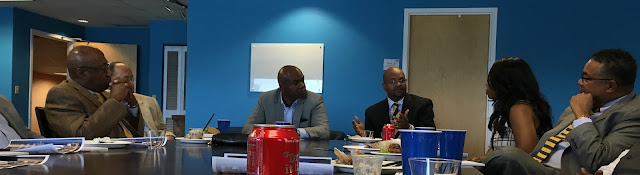
Manufacturers Darrell McNair of MVP Plastics and Larry Fulton of LEFCO Worthington share lessons from their experiences with MAGNET.

Butler shared his observation as a preface to a low-key session designed to introduce MAGNET*, the region’s leading nonprofit manufacturing consultant, to the small but significant number of northeast Ohio manufacturing firms owned by people of color. Butler and attorney Stacey Polk coordinated the session. The two are principals in LCR Enterprises LLC, which has been retained by MAGNET to aid the nonprofit’s inclusion efforts.


Ethan Karp, MAGNET CEO


MAGNET CEO Ethan Karp in his welcome spoke to the agency’s offices efforts to become more client-centric, and to serve more clients in the minority community. With refreshing candor, Karp said he knew how to help manufacturers solve problems but that he was clueless about the special challenges black businesses might face.


Two successful African American manufacturers were on hand to share their experiences working with MAGNET. Darrell McNair, CEO of MVP Plastics, a Geauga County Tier 2 supplier to the automotive industry, and a former MAGNET trustee, said he found the agency especially helpful in doing an assessment analysis related to his opening of a new plant last year in Texas. McNair related that most of his company’s business is done outside of Ohio, a frequent observation from many of Cleveland’s most successful African American business owners.

The group also heard from Larry Fulton, CEO of LEFCO Worthington, a manufacturer of wood crates. Fulton shared how MAGNET helped him improve LEFCO's employee engagement and achieve efficiencies in its manufacturing processes.

For the majority of attendees, MBE didn’t seem a big deal. Steve Williams, chief operating officer of Elson’s, said that in today’s climate, having MBE status might be good enough to get you in the door, but that a business must focus on solving problems for its customers. Elson’s CEO Andrew Jackson agreed, saying that he preferred being evaluated without reference to MBE criteria, citing MBE certification as a tool he used only when it benefitted his customer.

McNair offered perhaps the key takeaway from the session. “You can’t expect to grow without making an investment.”

After the session, attendees enjoyed a tour, with samples, of the Cleveland Whiskey plant on the first floor of the MAGNET facility.
Anthony Lockhart and Jason Estremera tour Cleveland Whiskey.

Acknowledging the importance of relationships in doing business, LCR’s Polk said that MAGNET would be hosting a follow up social gathering.

• • •
* Manufacturing Advocacy and Growth NETwork

Monday, August 01, 2016

Nina Turner to accept slot on Green Party ticket?

Ohio politician has history of going against the grain

(Reports have been circulating nationwide since yesterday that Nina Turner has been offered the Vice President slot on the Green Party ticket. Green Party presidential nominee Jill Stein tweeted about 4pm today that no offer has yet been made and that she is "in discussions with several strong candidates".)

It was a typically bold and courageous move when former Ohio State Senator Nina Turner surprised many in the political world and joined up with U.S. Senator Bernie Sanders in his pursuit of this year’s Democratic presidential nomination. She quickly became one of Sanders’ most prominent, vocal, and ubiquitous surrogates, opening rallies, introducing the candidate, and appearing on talk shows on a regular basis.

It was a bold move because Sanders was a distinct underdog with next to no recognition in the black community. Heck, he wasn’t even a Democrat, and Turner had just gotten through establishing herself as a major rising star in the Ohio Democratic Party. 

A swift and unpredictable rise

Turner’s political rise had been unusually swift and totally unpredictable. The eldest of seven children, her parents split up before she was five. Graduating from high school in 1986, she worked a variety of jobs before returning to school. But before turning 30, she had obtained associate’s, bachelor’s, and master’s degrees, along with getting married and starting a family.

Former Ohio State Senator Nina Turner
Turner’s first political position was in Columbus as legislative aide to then state Senator Rhine McLin of Dayton. She returned home to work in the administration of Cleveland mayor Michael White, rising quickly to become Executive Assistant of Legislative Affairs and then Director of Government Affairs for Cleveland public schools, which are under mayoral control. With the mayor’s blessing, in 2001 she ran for city council against the incumbent. She lost, but four years later, she beat his wife, who had succeeded him mid-term.

Turner took office in January 2006 but served substantially less than a full four-year term. When an unexpired term in the Ohio Senate came open in 2008, she leapfrogged several of her political seniors to win the appointment. She later won a full term and remained there until she was term-limited in December 2014.

Turner’s boldest move as a public official came in 2009, when she stood virtually alone among Cleveland-area black elected officials and backed a measure to reform a corrupt and obsolete county government that had been thoroughly dominated by the Cuyahoga County Democratic Party. Vilified by the party hierarchy and most of the black political establishment for her apostasy, Turner became a certified political star when the reform measure received overwhelming support countywide, including the black community. She ruffled establishment feathers again in early 2012 with a preliminary challenge to Congresswoman Marcia Fudge before backing off and serving out her state senate term.

The next year, she started running for Ohio Secretary of State, hoping to become the first-ever black Democrat to win a non-judicial statewide election. Although the entire Democratic slate went down in flames in November 2014, her campaign enhanced her stature within the party, and she became the virtual co-leader with incoming party chair David Pepper until she resigned to join the Sanders campaign.


Diverging from the Clintons

It is unclear what commitments Turner made to the Hillary Clinton camp, if any — Turner says none — but the Hillary forces, including the eventual nominee herself, saw Turner’s move as a betrayal, in no small part because Bill Clinton had helped raise funds for Turner’s statewide bid. While Clinton forces all but accused Turner of being an ungrateful runaway, Turner said she chose Sanders because his position on the issues resonated more with what she saw as the black community’s needs.

Clinton of course went on to defeat Sanders for the nomination after a surprisingly long and difficult struggle, in part because she kept a near lock on African American support.

Turner was a fierce and effective campaign Sanders advocate throughout the campaign, so no doubt the Clinton forces enjoyed the opportunity to thwart Sanders’ two attempts to reward Turner’s work. Although wild rumors had Turner being stripped of her credentials and evicted from the convention, the actual payback was her being denied the opportunity to introduce Sanders the first night and then to place his name in nomination the second night.


Turner’s choice

No one should doubt the independence of Turner’s political calculus or her willingness to go against the grain. I have heard her deliver many speeches to diverse groups; not once has she failed to reprise her grandmother’s injunction about the importance of having a strong backbone. Turner is clearly not a Hillary fan at this point, nor is she apt to feel any loyalty to the Party establishment.  Accepting the reported offer to run with Jill Stein on the Green Party ticket would likely raise Turner’s national profile, and probably that of the Greens as well.

But to what end? The Green Party will not win the Presidency. They more than likely will come in fourth, behind both major parties and the Libertarians.

At age 48 and with undeniable political ambition, Turner is potentially a future mayor of Cleveland; that seat could open up in 2021. If a Clinton victory led to a federal appointment for Marcia Fudge, Turner would be a frontrunner for Fudge’s District 11 Congressional seat.

Yet too many losing races will dim even the boldest star. While Turner has options, she will pay a steep price for siding with the Greens whether or not Clinton wins in November. Nobody would risk incurring the ire of Madame President, and given the alternative to a Clinton victory, it’s hard to think Turner would want to do anything that would contribute to a GOP win this fall.

Successful political careers are based on some alchemy of hard work, relationships, timing, and luck. Bold as she is, it’s hard to see Turner putting all her chips on a Green veep’s race. I expect her to leverage the Green Party offer, decline it with grace, and find a way to remain relevant until a likely open mayoral race in 2021. It won’t be easy after the way the Clinton forces dissed her last week, but Nina surely knows politics ain’t beanbag. Sure, on some level squelching Turner’s biggest national moment was personal, but that’s how the game is played.

Turner usually does the right thing for the community. With all that’s at stake nationally, indeed globally, as well as personally, look for Turner to keep whatever blue chips she still has and not exchange them for a self-destructive green one.
• • •