A New Day in Ohio Democratic Politics
Young black voices make themselves heard at candidate forum
COLUMBUS — When you see something for the first
time you can be hard pressed to find the words to describe it, especially if it's unclear whether what you’re watching is a one-off event or the harbinger of a new
day. So we won’t say what happened this past Saturday in the heart of a
Columbus ghetto was akin to the
appearance of the black monolith in Stanley Kubrick’s epic film, 2001 — A Space Odyssey.
 |
| Chadd Smith, president of Central Ohio Young Black Democrats, with OYBD media liaison Jewell Porter: "Black Votes Matter!" |
But the presence of every major Democratic candidate for statewide executive office at a
forum conceived, sponsored, and well-executed by a developing network of young
black activists certainly seemed to augur a new reality in Ohio Democratic
Party politics, where voters could see — up close and personal — candidates for statewide
office being x-rayed by a cadre of smart, savvy, tough, organized young African
Americans who wanted more than just direct answers to their prepared
policy questions.[1]
The Ohio Young Black Democrats also wanted to
send a message: Black Votes Matter.
The Setting
The tone for the day was set by Chadd Smith,
president of the Central Ohio YBD chapter. He made clear that the intent of the
“Black Votes Matter” program was “to show the power of the black vote both to
the black community AND to the mainstream”. He said OYBD wants to engage black
voters early in this year’s election cycle and had a three-fold strategy to do
so that involved targeted precincts, holding events around the state, and voter
registration.
One of the goals of the OYBD campaign, he said,
was to counter misconceptions about the voting process, including the one that
formerly incarcerated citizens are ineligible to vote.
The candidate forum and brunch at the Northern
Light branch of the Columbus Metropolitan Library was sold out in advance. At
$5 apiece the tickets were scooped up by an interracial and intergenerational
audience comprising a mix of sophisticated politicos and the civically
curious. The majority of attendees were
black, but a healthy number were loyal white Democrats, present because they
understood that the electoral victories they seek in November require the
support of an engaged black community no longer content to have its
concerns relegated to the policy sidelines.
The setting and the moderators combined to
produce an atmosphere that prompted true engagement and discouraged pandering.
The audience included at least one recently naturalized American citizen
concerned that single language ballots in his community did not speak to his
many neighbors whose first language was Nepali.
 |
| Esosa Osa is chief of staff for the Congressional campaign of Ken Harbaugh, running in Ohio District 7 |
Most candidates arrived early enough to network
with the audience. A few, including apparent crowd favorites Rich Cordray,
running for Governor, and state treasurer candidate Rob Richardson, arrived in
just-in-time fashion.
House Minority Leader Joe Schiavoni, also
running for governor, brought his entire family from Youngstown for the day, in
addition to his running mate, Stephanie Dodd of Buckeye Lake in Licking County.
Northeast Ohio was well represented on both
sides of the mike. Cleveland’s Dennis Kucinich was there with his running mate,
Akron councilwoman Tara Samples. William O’Neill, also running for governor,
was joined by his running mate, Chantelle Lewis and his scheduler, Mansell
Baker, both former East Cleveland city council members.
The Team
Dontavius Jarrells, a graduate of Cleveland East
Tech HS and Hiram College, currently serves as president of the Ohio Young
Black Dems. An early arrival, privileged to observe Jarrells and other group
members arrive to set up the event, could not help but note the egalitarian spirit
and camaraderie that animated the large team. All egos were pocketed as chairs
were set up, food was fetched and arranged, the sound system was installed, the
registration table prepared, and last-minute errand runners dispatched. The
team even had an operative in place to keep tabs on the GOP spotter who hovered
around, along with a knowledgeable media handler. This was a group intent on
dotting its “i”s and crossing its “t”s.
Gabrielle Jackson and Antoinette Wilson were
among the representatives of the Cleveland YBDs in attendance. Toledo and
Cincinnati were also in the house.
Moderating the event were Chenelle Jones and
Kyle Strickland. Jones is a
faculty member at Franklin University with a
research interest in criminal justice administration. Strickland, a Columbus
native, is a Harvard Law grad attached to the highly regarded Kirwan Institute for the Study of Race
and Ethnicity at Ohio State University.
 |
| Professor Chenelle Jones and Attorney Kyle Strickland kept the candidates on their toes. |
They kept the discussion on point with strong
and direct questions and were not hesitant to follow the occasional evasive
answer with a focused challenge or in some instances even a rebuttal.
The "Down-Ballot" Candidates
The program began with successive one-by-one
dialogues with State Rep. Kathleen Clyde, running for Secretary of State;
Cleveland lawyer Steve Dettelbach, candidate for Ohio Attorney General; former
Congressman Zack Space, running to become State Auditor; and Rob Richardson,
candidate for Ohio Treasurer.
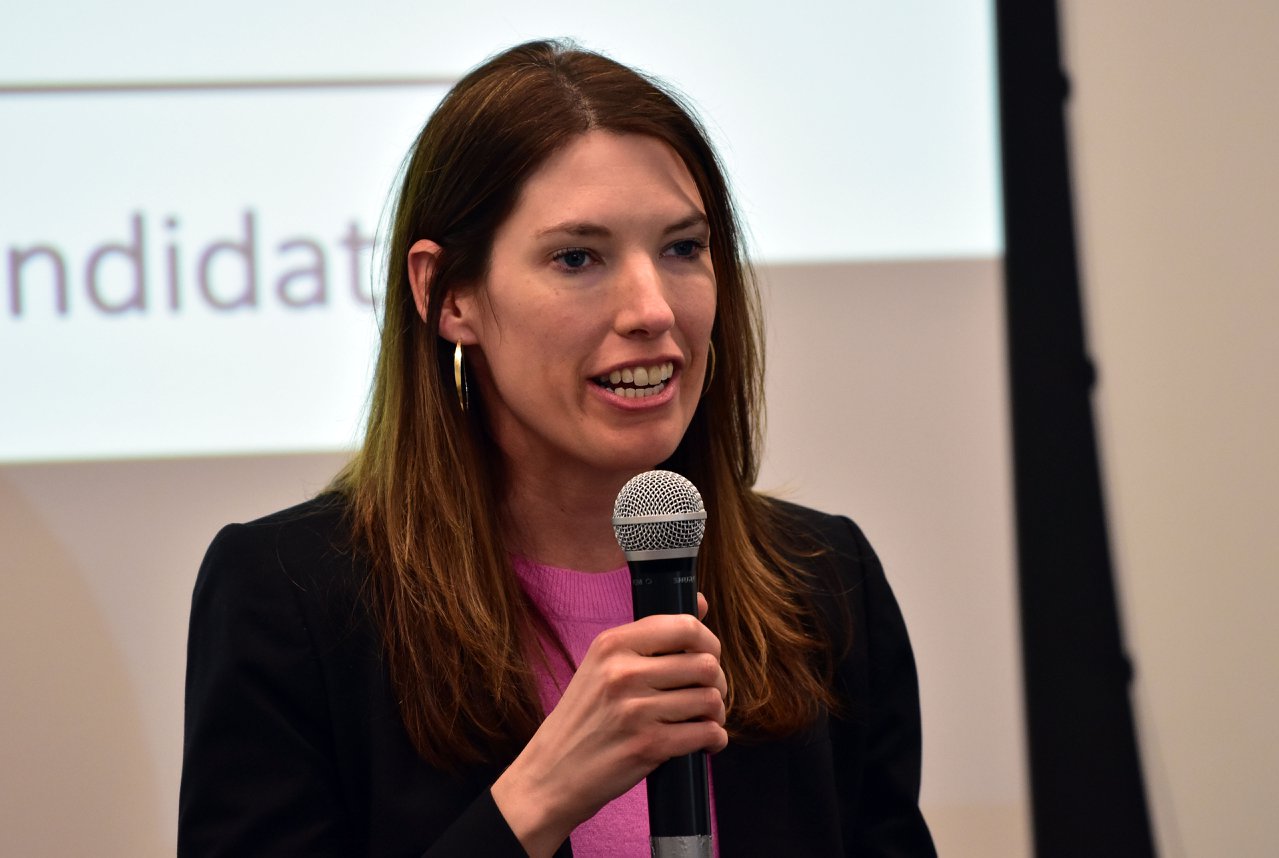 |
| State Rep. Kathleen Clyde, running for Secretary of State, thinks Ohio should protect its voting equipment against cyber attack. |
Each candidate had a few minutes to offer an
opening personal sketch and to close with a pitch for support. In between they
addressed questions from the moderators and the audience about their policy positions
on issues relevant to the offices they seek. Clyde for instance, talked about
automatic voter registration, GOP voter purging, and antiquated voting
equipment vulnerable to cyber attack.
 |
| AG hopeful Steve Dettelbach answers a question from the audience |
Attorney General hopeful Steve Dettelbach
emphasized the need to have one set of rules that apply to everybody. He
singled out gerrymandering, payday lending, and the charter school industry as
areas where special interests were served to the public’s detriment. He said
consumer protection, doing a better job combatting the opioid crisis, and being
smart on fighting crime would be among his priorities in office.
 |
| Former US Congressman Zack Space is running to be Ohio's next Auditor |
Auditor candidate Zack Space cited his
Appalachian roots and talked about the communities he said had been forgotten
by the political process. He said he would be a watchdog of taxpayer funds, and
a fierce foe of partisan gerrymandering. He said he would fight to maximize the
number of competitive voting districts. He also vowed to focus on the JobsOhio,
the Kasich program that takes public tax dollars and converts them to an
inscrutable private enterprise.
Asked what he had done to show that he was “not
just here to pander to the African American vote”, Space talked about his
middle-class upbringing and how he had volunteered in soup kitchens to learn
about issues of poverty. He said that taught him to see people impacted by an
unjust economy subject to rules they did not create and that aspirations to
social, racial and economic justice were dependent upon political justice.
 |
| Rob Richardson of Cincinnati is looking to become Ohio Treasurer |
Rob Richardson talked about his leadership at
the University of Cincinnati, where he founded the student chapter of the NAACP
and later became the chair of the school’s board of trustees. He said that
notwithstanding that his eight colleagues on the board were all Republicans, he
nevertheless forged a consensus that effectively addressed the university’s
positive response to issues of campus police misconduct, and fired the police
chief. He said that he would use the platform of the Treasurer’s office to
fight for people.
The state offices sought by the candidates
discussed above are often referred to as down-ballot races because contests for
those offices appear below the gubernatorial choices on the ballot. Too often
voters —perhaps feeling overwhelmed by a tumultuous mix of attention deficit,
information overload, and unfamiliarity with candidates and issues in these
non-marquee races — will skip these important ballot choices or vote the
straight party ticket they prefer. The consequences of their actions or lack
thereof are often felt literally right where they live, in the measure of
social, economic and political justice their neighborhoods receive.
Candidates
for Governor
Following a short brunch break, the forum moved
on to a lively exchange among the four candidates for governor.
Candidate O’Neill firmly planted his campaign
flag on the issue of legalizing
marijuana. He wants to legalize it immediately,
tax it at once to raise $500 million annually and combine those proceeds with a
projected savings of another $100 million in annual savings realized from the
release of an estimated 4,700 mentally ill people inappropriately locked in
prison. He would use the $600 million to address the state’s mental health and
opioid crises.
 |
| Former Ohio Justice Bill O'Neill thinks Ohio should legalize marijuana today, tax it and use the proceeds to combat the opioid crisis and help the mentally ill. |
Dennis Kucinich inveighed strongly against
“government taking our wealth and accelerating it to the top” with misdirected
and inequitable policies. He vowed to stop private charter schools, crush
fracking companies, and resolve the state’s burgeoning housing crisis with new
construction. He mixed his policy prescriptions with several references to his
running mate that came across as unsubtle reminders that she was African
American. In response to a question put to each candidate about diversity and
inclusion about their campaign organizations, Kucinich said, “I come from
communities of color” and that during his time as Cleveland mayor [1977-78] half
of his top appointments came from the black community.
Answering the same question, Rich Cordray listed
Ben Espy among his campaign co-chairs, referenced his senior strategist and
scheduler as people of color, and announced that he had just brought on Nelson
Devezin as his political director.
To his credit, Cordray didn’t brag about the
Devezin appointment, but it may
be historic: no political observer with whom we
spoke could identify a previous instance where a black man had been entrusted
with running a major gubernatorial campaign. [We have reached out to Devezin, a
native Clevelander, and hope to bring you a report on him soon. For now we note
that he is the son of former Cuyahoga County Common Pleas Judge Lillian Greene
and was the state party political director until he resigned late last year to
become public affairs director for the Franklin County recorder.]
 |
| Nelson Devezin is political director of the Cordray gubernatorial campaign. |
 |
| Ohio House Minority Leader Joe Schiavoni |
Joe Schiavoni attempted to score points during
his presentation by emphasizing his work holding down the fort against
Republicans in the General Assembly while Cordray was off in Washington and
O’Neill was on the bench and Kucinich was on Fox News. He backed up in the face
of subsequent retorts from his rivals.
 |
| Former US Congressman and Cleveland mayor Dennis Kucinich |
The candidates were in agreement on the need to
address disparities in our criminal justice system. Kucinich and O’Neill were
vocal in their opposition to the death penalty.
Cordray talked about how “we’ve been warehousing people”. But the
fireworks erupted around twin peaks of social injustice: race and sex. These
issues were encapsulated in the discussion around Scott Kaepernick and other
NFL ball players kneeling in protest during the national anthem and O’Neill’s
bafflingly ill-conceived attempt to defend then-U.S. Sen. Al Franken against calls
for his resignation over the latter’s repeated sexually predatory behavior.
O’Neill was somewhat apologetic for his Facebook
post in which he boasted of having bedded upwards of fifty women, and did so in
a way that allowed two of the women to be identified. He attempted to diminish
his post by calling them “silly words.”
 |
| Rich Cordray, right, with Stacie Bryant following the OYBD forum |
But Cordray would have none of it. He told
O’Neill his words were intentional and said that “words matter,” referencing
how the current President’s words regularly cause confusion and hurt, whether used intentionally or carelessly.
The tension between O’Neill and Cordray was also
stark when the NFL protests were discussed. O’Neill said he was an Vietnam
Veteran with a bronze star and that “I will not be at an event where people
disrespect the flag.”
O’Neill’s comment was not well received by most
in the audience, probably because they considered the notion of “disrespect” to
be a red herring, meant to deflect attention from the very issues the players
were calling attention to, namely, the unrestrained overuse of deadly force by
police across the country.
Cordray caught the mood of the audience in his
reply, which united both his view of the protest and his reply about “silly
words” noted above. He said that while protest at first seems to divide us,
“ultimately protest unites us”. He said that protest was about respecting other
people and wanting to engage with them. It was during his response that the audience
appeared most animated, the women old and young nodding heads and the
occasional injunction to “Preach!” being heard.
The Takeaways
The flawless manner in which the Ohio Young
Black Democrats and their constituent area chapters pulled off their maiden
event makes them the clear winner in terms of outcome. As Rowena Jelliffe, the
co-founder of Karamu House
once observed after a similarly impressive debut by a now-forgotten
organization of young people, “The trick is to do it again. And again.”

 We would also register mild sur
One might have thought that more of the state’s
major metropolitan dailies, each of which we understand to have a political
reporting presence in Columbus, might have been present. Likewise, no local
black publication — we think Columbus has three — saw fit to cover this event
in its own backyard.
Whether that’s a commentary on the candidates,
the sponsor, the venue or the times, it made us especially pleased to have been
present.
Finally, politicians often find it irresistible to pander to the audience. Our pander meter was plugged in for this event, but stayed pretty much throughout on the low register. We think that's a credit to the audience and the candidates, and the sense on behalf of most of the latter that there would have been little tolerance granted. It certainly made for a more robust and useful conversation.
 |
| A quartet of Ohio Young Black Democrats [L-R]: Chadd Smith, William Washington, Daniel Woodley and Julian Scott |
All photos by Daniel Porter, digital director at Ohio Democratic Party
# # #
[1] Lt. Gov. candidate Betty
Sutton was the sole absentee, not counting Connie Pillich, who was negotiating
her imminent withdrawal from the gubernatorial race. She withdrew yesterday and
endorsed Rich Cordray.
